Showing posts with label 10-Army: Korea. Show all posts
Showing posts with label 10-Army: Korea. Show all posts
Wednesday, February 10, 2016
No change of command ceremony
I can't make this up. My change of command ceremony got cancelled.
The Officer Selection Board results were just posted, and my successor was identified as one of the people to be separated from the Army. So instead of a change of command, I'll relinquish it without anyone selected to replace me for about a month or so.
I'm not worried about the ceremony itself. As an HHC commander, not many people would have been there anyway -- there's always something crazy going on that takes people away from stuff like this, and ceremonies really aren't that important to me anyway.
What bothers me, though, is that there's going to be a huge gap in continuity that's going to really mess up the company. It was hard enough for my first sergeant and me to do the work of three; he can't do everything by himself.
Still, in my experience, logisticians are an amazing group, especially in logistics battalions. We've come to almost *expect* crazy junk to happen. It's almost weird if it doesn't.
The good news is that I'm coming out of command tomorrow one way or another. I just hope things go smoothly next week so that we can catch our flight on time.


Monday, February 08, 2016
VTIP miscalculation
The Voluntary Transfer Incentive Program (VTIP) announcement for 3rd Quarter Fiscal Year 2016 came out this past week. The VTIP is the way Army officers transfer from basic branches into functional areas like Foreign Area Officer.
Unfortunately, the timing doesn't work well for me. One of the stipulations is that you have to be able to move no later than fall of 2017, and because of our upcoming move, that's not going to be possible. That's kind of a bummer.
It's all the more disappointing because it's a consequence of a decision I made in August of last year to try and get into the 16-01 assignment cycle. I figured I'd finish company command in December, and I didn't want to wait around not doing much. Especially given the OCONUS assignment choices at the time, I thought the 16-01 cycle would be a better choice than 16-02.
In terms of assignment, the decision was a good one, but the two month curtailment wrecks my application timeline. If I'd tried to extend into the fall, I might have been able to move straight into training, even if it meant staying in Korea a few more months.
It's not a complete loss, though. This decision looks like one of those "forks in the road" kind of things. This won't be my last opportunity to transfer, and my next assignment may more than make up for the delay.
Saturday, February 06, 2016
Since when was that info secret?
U.S. government agencies are battling over what information from Secretary of State Hillary Clinton's emails should be considered classified. It's a recurring issue because you can take unclassified bits of information and create a chunk of knowledge that someone else can then consider classified.[Source]
It's an issue I deal with even at my level in the Army with the monthly Unit Status Report. Every month, I report the unit's readiness levels as a sign of how ready we are to deploy. Not that this makes a whole lot of sense, since we're ALREADY in Korea, but it still has to be done (it IS the Army, after all).
The question is: when does information require a higher classification? In our unclassified networks, we might talk about fielding our "new" M4A1 rifles (not really new, but they're new to us). But if you create a report that wraps up the numbers and allocations along with the battalion's personnel readiness status, that's Secret.
What about in between? I've been in units where battalion information is Secret, but the company level information is unclassified. In others, even the company level report is Secret. Was there any conscious decision one way or the other, or was it simply organizational inertia?
Declaring it unclassified at the company level kept things expedient -- companies could do their individual reports before compiling them all on the one classified computer the battalion had. It prevented us lieutenants from wasting endless hours waiting around for someone else to finish their report.
But this is the Army. Anytime you do something different, you leave yourself open to criticism, especially if someone else decides what you're doing -- in the interest of expediency and time efficiency -- creates a security risk.
That's probably what's going on with Clinton's emails. It's one thing for a colonel to make a classification decision for regular reports. It's quite another when you're a Cabinet Secretary dealing with the dynamic issues of global diplomacy on a real-time basis. And nobody likes being second-guessed by a bunch of back room analysts with no leadership responsibilities for anything. (see 1992's "You can't handle the truth!" scene from "A Few Good Men.")
Adam B. Schiff of California, the top Democrat on the House Intelligence Committee, put it this way: “While the secretary of state has a duty to protect classified information, as all of us do in a position of trust, here she did not have the benefit of six-plus months of interagency classification reviews....The same information said by people in two different positions may receive two opposite classification determinations.” [Source]
Friday, February 05, 2016
Decision: Need more paperwork
So the big day finally arrived. I met with the brigade commander for my change of command out-brief, and I have no financial liability that will prevent me from moving to my next duty station. That's the good news.
 However, I have a bit of homework to do. Last March, my company turned in a nasty, rusted out container full of excess junk (the one marked 4786-6). Though the junk inside was not on my property book, the container itself was. And though the container was nearly useless (and to my knowledge, destroyed for scrap), I still have to fully account for it.
The document that I had gotten when I'd turned it in, however, does not meet relevant standards.
 So it's my job to track down any third party documentation that would indicate what I've got is a valid document.
In the meantime, I'm not flagged, which I guess means I'm free to outprocess. That's definitely a good thing.
Just the same, I probably won't really feel completely at ease until I'm actually on the plane.
However, I have a bit of homework to do. Last March, my company turned in a nasty, rusted out container full of excess junk (the one marked 4786-6). Though the junk inside was not on my property book, the container itself was. And though the container was nearly useless (and to my knowledge, destroyed for scrap), I still have to fully account for it.
The document that I had gotten when I'd turned it in, however, does not meet relevant standards.
So it's my job to track down any third party documentation that would indicate what I've got is a valid document.
In the meantime, I'm not flagged, which I guess means I'm free to outprocess. That's definitely a good thing.
Just the same, I probably won't really feel completely at ease until I'm actually on the plane.
Tuesday, February 02, 2016
Judgment Day moved to the right
Wednesday, February 3rd was supposed to be my judgment day -- the day when I met with the brigade commander to discuss the change of command from me to the next guy. Instead, it will be Friday the 5th.
If he gives me the thumbs up, the change of command ceremony takes place on the 11th and I'll leave Korea about a week later. If I get a thumbs down, it will create a big mess and I don't really know how things will work out.
There are two ways the Friday meeting can go badly. The first relates to an $11,000 twenty-foot container that got turned in about a year ago. I have the turn-in document, but it was signed by a person that didn't have the proper authority to do so. The easy solution is a "short FLIPL," an administrative adjustment that would acknowledge there was no negligence involved and I leave happily. The more painful alternative would be a full-blown investigation that delays my departure timeline.
The second way this can go badly relates to equipment shortages. When I took command, I didn't know enough about how things were supposed to go to document all the components on hand. Although we've since fixed that problem, there's the question of how to recognize the difference. (In Army math, "I don't know" minus "a lot" can equal "a lot of junk is missing and it's your fault.")
If the brigade commander orders an investigation to look into the cause of the equipment shortages, this also might take a lot of time and may even cost me a month's base pay. There are all kinds of reasons for why this couldn't be resolved earlier, but even a zero-liability finding won't matter if I get stuck here doing nothing and my orders get deleted.
So I have until Friday to develop my briefing. Although I think it will go well, you never can tell. And my faith that "everything will be OK" is not congruent to my hope that "things will go the way I want them to."
Sunday, January 31, 2016

Sunday, January 24, 2016
Wheaton College. Prof. Hawkins, and the Army
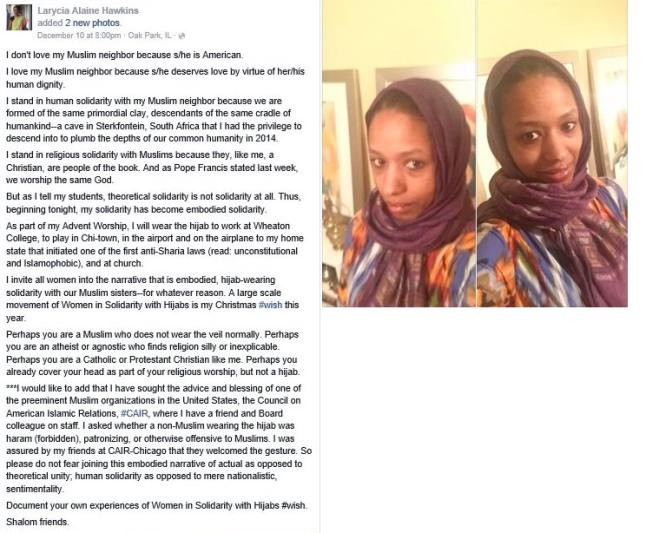
In December 2015, Professor Larycia Hawkins wore a hijab. As she stated in her December 10th Facebook message,
 On December 15th, Provost Stan L. Jones sought clarification on her perspectives. Wheaton College employees must sign a Statement of Faith annually, and he believed several of her Facebook statements conflicted with various aspects of the Statement. She complied.
Apparently, it wasn't good enough. According to a statement from the college, "While her statement was thoughtful, well-written, and would probably be acceptable as part of a new faculty application, given the particular issues raised, he felt that further conversation was indeed needed. [Source]
At that point, she refused to make further statements, which led to an "impasse." For its part, according to the Washington Post, the college "did not answer a question about what specifically the college was looking for her to clarify in follow-up conversations." [Source]
On January 5th, Wheaton College initiated termination proceedings against Dr. Hawkins. [Source]
Darrell Bock, one of the 17-member board of trustees, said that it has turned into a personnel matter. If that's the case, there are a slew of problems right around the corner. Faculty are watching the process closely; if even the theology department is divided, "what would happen to them if the college maintains her statement does not adhere to the statement of faith?" [Source]
And then there's the whole equal opportunity issue. Hawkins is one of Wheaton’s five black tenured professors, who make up 2 percent of the faculty, and its only full-time black woman professor. [Source] What does it say about the nature of Wheaton College if it can't suffer the diversity of beliefs in its own staff?
Wheaton may say that the issue was Hawkins' refusal to further clarify the issue, but a column from USC's Religion Dispatches believes Wheaton isn't being honest about the real issue. Whatever Hawkins says, Wheaton will split hairs because it's using the issue for its own publicity.[Source]
It's an issue that has faced Wheaton in the past -- is it a legitimate institution for higher learning, or a vehicle to promote a particular brand of evangelical orthodoxy? Two instances within the military science department come to mind.
A few years ago, the Army published an ROTC position for Wheaton in the senior captain's list. Its "Must be of Christian faith" requirement drew the ire of the Military Religious Freedom Foundation. The foundation argued the requirement was an unconstitutional religious test.[Source]
Plus, in an April 2013 article, its ROTC program self-identified "as the only Christian ROTC program in the nation." [Source]
So, what is Wheaton College all about? I look forward to the February 11th hearing.
I stand in religious solidarity with Muslims because they, like me, a Christian, are people of the book. And as Pope Francis stated last week, we worship the same God. [Source]Apparently, this was controversial. Though her employer, Wheaton College, took no issue with the headscarf (they avoided the term "hijab"), her intent to associate with Islam touched a nerve.
On December 15th, Provost Stan L. Jones sought clarification on her perspectives. Wheaton College employees must sign a Statement of Faith annually, and he believed several of her Facebook statements conflicted with various aspects of the Statement. She complied.
Apparently, it wasn't good enough. According to a statement from the college, "While her statement was thoughtful, well-written, and would probably be acceptable as part of a new faculty application, given the particular issues raised, he felt that further conversation was indeed needed. [Source]
At that point, she refused to make further statements, which led to an "impasse." For its part, according to the Washington Post, the college "did not answer a question about what specifically the college was looking for her to clarify in follow-up conversations." [Source]
On January 5th, Wheaton College initiated termination proceedings against Dr. Hawkins. [Source]
Darrell Bock, one of the 17-member board of trustees, said that it has turned into a personnel matter. If that's the case, there are a slew of problems right around the corner. Faculty are watching the process closely; if even the theology department is divided, "what would happen to them if the college maintains her statement does not adhere to the statement of faith?" [Source]
And then there's the whole equal opportunity issue. Hawkins is one of Wheaton’s five black tenured professors, who make up 2 percent of the faculty, and its only full-time black woman professor. [Source] What does it say about the nature of Wheaton College if it can't suffer the diversity of beliefs in its own staff?
Wheaton may say that the issue was Hawkins' refusal to further clarify the issue, but a column from USC's Religion Dispatches believes Wheaton isn't being honest about the real issue. Whatever Hawkins says, Wheaton will split hairs because it's using the issue for its own publicity.[Source]
It's an issue that has faced Wheaton in the past -- is it a legitimate institution for higher learning, or a vehicle to promote a particular brand of evangelical orthodoxy? Two instances within the military science department come to mind.
A few years ago, the Army published an ROTC position for Wheaton in the senior captain's list. Its "Must be of Christian faith" requirement drew the ire of the Military Religious Freedom Foundation. The foundation argued the requirement was an unconstitutional religious test.[Source]
Plus, in an April 2013 article, its ROTC program self-identified "as the only Christian ROTC program in the nation." [Source]
So, what is Wheaton College all about? I look forward to the February 11th hearing.
Thursday, January 21, 2016
84% in 1.5 days
The Army prescribes 30 days for a change of command inventory. I've been working on mine since mid-November, though the start was pushed back by two weeks for scheduling issues.
On Tuesday, my replacement and I went into a meeting to discuss where we were at, and -- to my surprise -- he wasn't ready. The property book officer had given him a more current printout of what property was in the company, and he hadn't finished reconciling it yet. The meeting was postponed until Wednesday.
By Wednesday's meeting, he had reconciled everything. Early in the morning, I'd asked if there were any other problems besides the one I knew about (quantity of gas mask), and he said no. OK, good; ready to go.
You can imagine my surprise, then, when he was asked if he'd seen everything, and he answered there was a whole bunch of stuff he hadn't seen. Like, 85 line items of stuff. I was shocked. This is the kind of thing you let someone know waaaaaay before a meeting.
But this wasn't a problem with him not seeing stuff -- he's been seeing stuff for six straight weeks. This was a problem with rotten record keeping, as evidenced by the fact that -- of the 85 line items -- two thirds were from the supply sergeant's hand receipt. If nothing else, he could have told the guy he's been walking around with for the past month and a half.
So there we were, two days before we have to brief the battalion commander, and we've got 85 lines of stuff to go back and see plus 200 gas masks to account for. What a kick in the teeth.
It's a good thing I've been taking care of my property. That evening, we "found" 44 of the "missing" items. Today, we took care of another 27, fixing 84 percent of the problems in a day and a half. There are only 14 more items to go -- an assortment of crusty, old, and broken monitors, printers, and computers that are destined for turn in anyway.
If I can find the rest by the middle of next week, the only thing I'll have to account for is accompanying parts (like wrenches that go with trucks). It's likely I'll be able to avoid an investigation.
But if not, I've been preparing my defense. My company and I have been through some crazy experiences in the past 18 months -- a company deactivation, a company activation, the 2015 Combined/Joint Logistics Over The Shore exercise, and several smaller field exercises. I may not have been able to accomplish all my supply goals, but I've had a number of setbacks that I hope can be acknowledged.
It would be nice to leave on time.
Sunday, January 17, 2016
Why I'm afraid of the parking garage

 That's an Audi, a Mercedes, a BMW, a Porsche, and a Toyota Midship Runabout. I've already hit the BMW through carelessness. I don't need to hit any more.
Saturday, January 16, 2016
The military marriage distortion
In the private sector, your family status is a complete non-issue. While the question comes up when you're filling out your W-2 forms, employers aren't allowed to ask questions about your family during the interview process. If anything, a family can be seen as a distraction.[Source]
 The Army is quite different when it comes to your personal life.
First, it's gets all up in your business. As a single, junior enlisted soldier, you must have a meal card and live in the barracks, which is kind of like living in a college dormitory, but with fewer females around.
If you're married, there's the question of how much involvement they want in the Family Readiness Group. If you live on-post, a home visit from your commander can be expected. And if you're Korea as a command sponsored family, there's more -- your unit has to make sure they're ready for a non-combatant evacuation. There are all kinds of requirements.
Second, and this is the good news -- having a family means you make more money. Your Basic Allowance for Housing (BAH) goes up, the Cost of Living Adjustment increases, and if you live on-post, you may even get a bigger house just for having a bigger family.
These benefits lead to some weird incentives. Notice the part that said *single* junior enlisted soldiers have to live in the barracks -- married junior enlisted personnel don't. They get family housing.
 And so you get situations like this (a Marine, yes, but the situation still applies). Though it doesn't happen in Korea quite as much, I have seen soldiers do the darnedest things to live off-post -- ill-advised marriages to ... uh... "sub-optimal" spouses being one of them. Surprisingly, I haven't yet seen a Chuck & Larry type incident, but I'm sure they're out there.
It also affects the ... uh ... single female demographics outside of military installations. First, there's the type of young ladies that are found around military bases, which -- just like the nature of young men's fancies -- has never changed.
But since 2003 there's been another type. As wages in the private sector have stagnated, military compensation has grown better by comparison, especially with all the deployments that took place. Soldiers coming back from deployment(s) to Iraq or Afghanistan were swimming in money they didn't know how to handle, and they were likely to deploy again.
This created powerful incentives to enterprising young people who understood marriage and property laws, and who had access to joint checking accounts.
The conclusions to those stories are often sad. While you'd decry an institution who'd repossess a deployed Soldier's house or stole their money, some soldiers have had this happen to them -- by their spouses.
Due In part to the strange incentives the military offers to the married.
The Army is quite different when it comes to your personal life.
First, it's gets all up in your business. As a single, junior enlisted soldier, you must have a meal card and live in the barracks, which is kind of like living in a college dormitory, but with fewer females around.
If you're married, there's the question of how much involvement they want in the Family Readiness Group. If you live on-post, a home visit from your commander can be expected. And if you're Korea as a command sponsored family, there's more -- your unit has to make sure they're ready for a non-combatant evacuation. There are all kinds of requirements.
Second, and this is the good news -- having a family means you make more money. Your Basic Allowance for Housing (BAH) goes up, the Cost of Living Adjustment increases, and if you live on-post, you may even get a bigger house just for having a bigger family.
These benefits lead to some weird incentives. Notice the part that said *single* junior enlisted soldiers have to live in the barracks -- married junior enlisted personnel don't. They get family housing.
And so you get situations like this (a Marine, yes, but the situation still applies). Though it doesn't happen in Korea quite as much, I have seen soldiers do the darnedest things to live off-post -- ill-advised marriages to ... uh... "sub-optimal" spouses being one of them. Surprisingly, I haven't yet seen a Chuck & Larry type incident, but I'm sure they're out there.
It also affects the ... uh ... single female demographics outside of military installations. First, there's the type of young ladies that are found around military bases, which -- just like the nature of young men's fancies -- has never changed.
But since 2003 there's been another type. As wages in the private sector have stagnated, military compensation has grown better by comparison, especially with all the deployments that took place. Soldiers coming back from deployment(s) to Iraq or Afghanistan were swimming in money they didn't know how to handle, and they were likely to deploy again.
This created powerful incentives to enterprising young people who understood marriage and property laws, and who had access to joint checking accounts.
The conclusions to those stories are often sad. While you'd decry an institution who'd repossess a deployed Soldier's house or stole their money, some soldiers have had this happen to them -- by their spouses.
Due In part to the strange incentives the military offers to the married.
Friday, January 15, 2016
We're in South Korea.
It surprises me when I hear about people who can't remember which Korea is the "good one." Here's a line from an email I got a while back from a soldier's attorney asking for their contact information:
I know this is a strange email (you are in North Korea, and without trying to offend anyone, those North Koreans appear from my vantage point, very irrational) but you listed yourself as a point of contact ....In my response, I included the following:
I will pass along your contact information. Please note we are in South Korea, where people are much more "rational" and democratic. If we were actually in North Korea, it would be because we were conducting an invasion, and [soldier's name] would be staying a good bit longer than originally planned.Maybe that came off a bit snarky, but c'mon -- the guy was an attorney. They're supposed to be smart. And his client was IN Korea -- was it not worth knowing which half?
"Natural Born Citizen"
Ted Cruz has a funny problem for a Republican -- he wasn't born in the United States. Thus, after years spent dealing with President Obama's "birther" issue, it's possible our next president could end up dealing with the same idiocy all over again.
As the father of a child with a consular Certificate of a Birth Abroad, I find the level of ignorance on this subject completely appalling. The fact is, it doesn't matter if you're born in Antarctica -- if one of your parents was a U.S. citizen [who has lived in the U.S. (interpreted broadly) for at least five years] then you get "natural born" citizenship. In other words, you don't have to naturalize in order to be considered a citizen.
Adding to the irony is Cruz's "originalist" way of interpreting the Constitution. Originalists look to the original intentions of the Founding Fathers, whereas "living constitutionalists" try to apply terminiology to current situations. In this, Cruz is at a disadvantage, as Harvard law professor Laurance Tribe explains:
The more of a genuine ‘originalist’ someone (like Cruz) is, the harder it becomes to resolve that ‘serious question’ in Cruz’s favor. The more of a ‘living constitutionalist’ someone (like me) is, the easier it becomes to conclude that ‘natural born citizen’ has gradually acquired the broader meaning on which Cruz necessarily relies. [Source]So how would the Constitution's framers have thought of Cruz's situation? According to the source cited above, the founding fathers generally feared widespread “intrigue” by foreigners. Democracy was a new thing for everyone, and they were afraid foreign governments or their agents would dominate the new government. It's quite possible they'd be suspicious of someone born outside national borders, believing them to be subject to foreign influence. This would have been especially true for Canada, which was controlled by Great Britain. I'd prefer that this line of discussion disappear entirely from the scene, but sadly this will not be the case. From what I can tell, these days not many people seem all that interesting in troublesome things like facts or truth -- it seems bombastic nonsense and celebrity appeal are the only qualities necessary to be popular. It's all quite frustrating, but while it lasts, I'm interested in seeing how Cruz deals with it.
What's taking so long?
It's been about two months now, and my change of command inventory still isn't completely done.
Normally, it wouldn't take longer than one month, but I lost two weeks because someone important didn't like the way I failed to include lunch breaks on the schedule. That pushed the actual start from mid-November to the beginning of December.
Since then we've had three four-day weekends, requiring an extension request. Adding to the difficulty is the fact my property book includes about 30 "sets, kits, and outfits" which take a LONG time to go through. These items, such as like the T24660 Tool Room, are comprised of up to 218 pages (with six items per page) of components and sub components.
 Here's an example -- some flint tips for a blowtorch igniter. They constitute one line in about 150 pages of components, despite the fact the only time anyone ever touches them is when there's an inventory. Though it would probably make sense to get rid of them, they stay filed away in a drawer with the yellow tag on them the other 99.9% of the time.
Why? Because Army Regulation 710-2 §2-6 states "Commanders will ensure that equipment and components listed in the authorized column (of the MTOE and TDA) are on hand or on request." Since the end product -- the W32730 Common #2 Tool Room -- is a required item, I can't get rid of any part of it while it's still serviceable.
The real kicker is that the Common #2 Tool Room was deemed obsolete back in 2014, yet no one at a higher level seems to want to replace with more modern equipment. I guess that would cost money.
 Here's another bundle of joy: my W89557 warehouse tractor. This thing was originally meant to shuttle around parts on luggage trailers, but is now also obsolete. It looks like it came straight out of the 1960s.
As the primary hand receipt holder, the way to fix it would be to submit changes to the authorization document, which I've done. I've submitted the required DA Form 4610-Rs to higher levels, but the impression I get is that it will take command channels to drive the change, and neither modernizing nor "right-sizing" equipment is really a high priority right now. The unit will be stuck with ridiculous levels of nearly useless stuff for the time being.
So here we are, mid-January, and we're almost -- but not quite -- done.
In the meantime I've nihilistically started collecting old stuff from first aid kits. Like the other things, these outdated items that are required as part of a vehicle's Basic Issue Items (BII) but would cost money to replace.
On my desk is a bottle of iodine that expired in 1991. I've also got some ammonia inhalants (like smelling salts) that expired in June 2004 -- still in their original plastic wrapping.
 How sad, right? But who knows -- like baseball cards, maybe one day they'll be worth some money.
Here's an example -- some flint tips for a blowtorch igniter. They constitute one line in about 150 pages of components, despite the fact the only time anyone ever touches them is when there's an inventory. Though it would probably make sense to get rid of them, they stay filed away in a drawer with the yellow tag on them the other 99.9% of the time.
Why? Because Army Regulation 710-2 §2-6 states "Commanders will ensure that equipment and components listed in the authorized column (of the MTOE and TDA) are on hand or on request." Since the end product -- the W32730 Common #2 Tool Room -- is a required item, I can't get rid of any part of it while it's still serviceable.
The real kicker is that the Common #2 Tool Room was deemed obsolete back in 2014, yet no one at a higher level seems to want to replace with more modern equipment. I guess that would cost money.
Here's another bundle of joy: my W89557 warehouse tractor. This thing was originally meant to shuttle around parts on luggage trailers, but is now also obsolete. It looks like it came straight out of the 1960s.
As the primary hand receipt holder, the way to fix it would be to submit changes to the authorization document, which I've done. I've submitted the required DA Form 4610-Rs to higher levels, but the impression I get is that it will take command channels to drive the change, and neither modernizing nor "right-sizing" equipment is really a high priority right now. The unit will be stuck with ridiculous levels of nearly useless stuff for the time being.
So here we are, mid-January, and we're almost -- but not quite -- done.
In the meantime I've nihilistically started collecting old stuff from first aid kits. Like the other things, these outdated items that are required as part of a vehicle's Basic Issue Items (BII) but would cost money to replace.
On my desk is a bottle of iodine that expired in 1991. I've also got some ammonia inhalants (like smelling salts) that expired in June 2004 -- still in their original plastic wrapping.
How sad, right? But who knows -- like baseball cards, maybe one day they'll be worth some money.
Netflix to cut VPN access to U.S. accounts
The Army assigned my family and me to Korea in April 2013. We've spent almost three straight years overseas.
While I like Korea, there are definitely things that I miss about living in the U.S. I miss watching NFL games on Sunday afternoons. I miss the variety of American restaurants (a lot don't have a presence here). And I miss being able to understand the majority of conversations going on around me.
I also miss the benefits that come from just being in the U.S. -- don't want to buy a song online? Get it from Spotify. Want to cook something you can't find in your neighborhood? Amazon two day delivery. Want to watch every possible Hollywood movie? The multiplex has all of them, and if you couldn't make it, there's Redbox.
Being a service member's easier than being an English teacher -- the APO address gets you domestic shipping rates, the on-post gas station is way cheaper, and the commissary has the food you're used to. Plus there's the AFN channel so you can stay connected with pop culture.
Virtual Private Networks (VPNs) help bridge the gap, too -- VPNs essentially "fool" content providers into thinking you're in the U.S., bypassing the regional licensing restrictions that prevent overseas audiences from seeing U.S. programs. So even if AFN didn't play your favorite show, VPNs allow you to get it from Netflix or Hulu or whatever. And you don't miss out on the best SNL skits embedded into on-line reviews.
Netflix is changing that.
According to this Australian article, Netflix will be "cutting off VPN users from accessing content from its international catalogues." [Source]
Netflix's decision will, of course, affect service member's ability to access American television series, and will probably lead to a lot of cancellations. I, for one, am not interested in paying to watch what Netflix licenses in South Korea -- Netflix's U.S. content will always offer greater wider variety.
Sadly, I'll probably just cancel my account -- if I can't access the Netflix content that I've been paying for (up to this point), then why bother?
Tuesday, January 12, 2016
All White Party to celebrate MLK Jr Day
Some things are too incredible to make up.
 I understand that the idea is -- as the sign says at the bottom -- "Everyone wears all white," but somehow that just makes it worse.
Tuesday, January 05, 2016
Ethics and the Quarterly Training Brief
In February 2015, the Army War College Strategic Studies Institute published "Lying to Ourselves: Dishonesty in the Army Profession." It described the way the Army's incessant bureaucratic demands force Army officers into either lying about accomplishments or admitting professional failure. As one officer put it,
“It’s a systemic problem throughout the entire Army . . . We can probably do two or three things in a day, but if you give us 20, we’re gonna half-ass 15 and hope you ignore the other five.”Dealing with this reality leads to "ethical fading" – a tendency to dismiss dishonesty as an ethical shortcoming and instead embrace it a necessary quality for success. The Army Times article from February 19th has a good summary. As I wrap up my last quarterly training brief, the article seems especially poignant. In a few days, I’ll present my company’s training situation to my senior rater along with the plan for the next three months. Yet as I self-report my company’s training status, I can’t help but question what the whole exercise is really about. Is the purpose of the QTB to report accurate numbers, explain training constraints, and identify areas for professional development, or is it to give higher echelons an opportunity to assess us company commanders? From what I can tell, it definitely isn’t the former – it’s a test, and this is my last chance to get an A. Consider this: if you were a brigade commander and wanted to know training statistics, you could simply walk over to your S-3 and have them pull up the statistics for any battalion or company. By looking at the numbers like this, you could then determine whether the problem was 1.) A unit is not doing the training, 2.) A unit is not uploading their training data, or 3.) The S-3 hasn’t given the guidance on what specific task people are supposed to upload. But that’s not how things work. Normally, the brigade S-3 sends out a template and says “fill this in.” Subordinate units fill in their own data and present it to the brigade commander in a big conference. As long as people don’t draw attention to themselves by boasting outrageous levels of success, no one compares the numbers with what’s in the online records. While this process may allow brigade commanders to test our briefing skills, it sets up a HUGE conflict of interest and almost certainly distorts everyone’s perceptions of reality. Can you really expect people to be completely honest if no one checks and people self-report? Imagine a police officer pulls you over for speeding, says he didn’t have his radar gun on, and asks if you indeed broke the law. If you say yes, he’ll ticket you; if you say no, he’ll leave you alone. What would you say? It’s the same thing. Being completely honest is a particularly difficult issue for me as an HHC commander because the battalion staff all have “day jobs” throughout the week. Roughly half of my company is an E-7 or higher – do these people really need to train on throwing hand grenades or how to react to enemy contact? Officially, the answer is yes. According to regulation (AR 350-1) and policy, there’s no exemption for senior leaders – you’re either trained or untrained. Yet without higher level inspections on training quality (or hardly anything else, for that matter), it doesn’t really seem worth it to focus on strict training completion when there are 8 million other things to worry about and (as an HHC commander) I don’t have an executive officer. Plus, there’s this general feeling that “it doesn’t really matter anyway.” We may be one of the most forward deployed units in the world, but that doesn’t mean our equipment shortages are going to get filled. Neither do we get fully trained personnel– instead, we’ll get the soldiers fresh out of initial entry training that require on-the-job training for basic tasks. And despite the fact that NCOs now *must* complete the Basic Leaders Course in order to get promoted, that doesn't mean my people will get class slots. The Army's already chosen its winners. So should I deliberately inflate my numbers to meet norms within my battalion? As the report quotes another officer,
“You’re a bad leader and you failed if you didn’t get everyone through the hour-long human trafficking thing. All the other company commanders in the United States Army somehow managed to do it and you’re gonna be the only guy that didn’t do it because you [truthfully] reported 85%.”This need to “feed the beast,” “check the box,” and “pencil whip” one’s way through requirements not only conflicts with efforts to establish the armed forces as a profession but also pushes important risk decisions onto company grade leaders. Do you really want company commanders deciding what they’re going to focus on or ignore, or should those decisions be made by someone higher? Sadly, as we junior officers in the Army face further reductions in coming years, this generation of leaders is learning not how to show moral courage, but how to survive through deceit. Truth does not matter – it’s making your boss look good with plausible deniability. Sticking out won’t get you promoted, but it can get you eliminated – only those who blend in benefit. Encouraged by a system of deliberate blindness, we learn to lie to ourselves.
Sunday, December 27, 2015
Not sure the Finns appreciate this...
Finland's not part of Scandinavia, despite the perceptions of both Koreans and Americans.
 Though, yes, they are all small countries in northern Europe, Finnish is a distinctly different language. In fact, structurally it has more in common with Korean than it does with the Scandinavian languages.
Wikipedia's article seems to specifically address our misperception, describing Finland's inclusion with the other countries as "The abnormal use in English." [Source]
Though, yes, they are all small countries in northern Europe, Finnish is a distinctly different language. In fact, structurally it has more in common with Korean than it does with the Scandinavian languages.
Wikipedia's article seems to specifically address our misperception, describing Finland's inclusion with the other countries as "The abnormal use in English." [Source]
Saturday, December 26, 2015
There's a poor choice in here somewhere
Whatever this woman's achievement was, I applaud it, but I think the organization that selected her could have made a better choice for the *name* of the award.
 Perhaps it's better they didn't put her name (or age) on it.
Thursday, December 24, 2015
Force to reckon with -- in 4D
I took my son to see SW: TFA on the 17th. (This was a day earlier than it opened in the U.S. Heh, heh, heh.) Rather than wait for it to show on post, we saw it in a Korean theater in the standard, 2D format.
 Today I took him to see it in the 4D format, which is, like, (uh... four squared is sixteen..) 16 times better. In a 4D theater, you not only watch the movie in its 3D format -- it's a physical experience. The chair shakes, tilts, and vibrates. Fog rolls in, and mist shoots out of your seat.
 It was the first time I'd been in a 4D show, but I figured that if I wouldn't bother going for a Star Wars movie, I'd probably never bother for anything else. It sure was pricey enough -- 18,000 won for me and 13,000 for P (about $30) -- but still worth it, if only so I'll never have to regret not going. With snacks an all, I blew close to $50, but I'd do it again.
Oh, and just so you know -- if you order the buttered/grilled squid in a Korean movie theater, they'll ask if you want body (몸통) or tentacles (다리). Tentacles will cost about $1 more, but that's what most people like. Nevertheless, I recommend the body because it's softer.
 One of the things I'll miss most about where we live now is that movie theaters and all kinds of restaurants are within walking distance. It's only too bad that so much of my time these past three years was spent on career-related requirements. I'd have liked another year to fully enjoy the place.
Today I took him to see it in the 4D format, which is, like, (uh... four squared is sixteen..) 16 times better. In a 4D theater, you not only watch the movie in its 3D format -- it's a physical experience. The chair shakes, tilts, and vibrates. Fog rolls in, and mist shoots out of your seat.
It was the first time I'd been in a 4D show, but I figured that if I wouldn't bother going for a Star Wars movie, I'd probably never bother for anything else. It sure was pricey enough -- 18,000 won for me and 13,000 for P (about $30) -- but still worth it, if only so I'll never have to regret not going. With snacks an all, I blew close to $50, but I'd do it again.
Oh, and just so you know -- if you order the buttered/grilled squid in a Korean movie theater, they'll ask if you want body (몸통) or tentacles (다리). Tentacles will cost about $1 more, but that's what most people like. Nevertheless, I recommend the body because it's softer.
One of the things I'll miss most about where we live now is that movie theaters and all kinds of restaurants are within walking distance. It's only too bad that so much of my time these past three years was spent on career-related requirements. I'd have liked another year to fully enjoy the place.
This can't be safe
There's a Christmas tree in the subway station that's near our house.
 I don't think they're supposed to do this...
Subscribe to:
Posts (Atom)