Showing posts with label 04-Life in Korea2. Show all posts

Saturday, June 12, 2010

Babies in two countries - compare & contrast

Having a baby in Korea was quite an experience, but it was hard to make comparisons before having one in my home country. Granted, having one in an Army hospital is a bit different than in a civilian one, but hopefully the comparison is still relevant.
  1. The biggest difference was that we didn't have to pay a cent this time. In Korea, the final charge was about $2,000.
  2. In Korea, photographers did a "glamour shot" style photo package; it was very professional. Here, the photographer came around and offered us a series of prints -- but of just one photograph. I said no thanks -- there was no reason to spend $50 for prints I can develop at Walmart for less than $10.
  3. In Korea, the style of care was a bit different. We spent the first night in a private room, then moved to a six-person bay with curtain separators. P stayed in a nursery, nurses took care of his diapers, and when he needed to be fed they'd wheel him in. We stayed a total of seven days there. Here it was 48 hours. We had a private room the whole time, and C stayed with us in the room. We changed her diapers, and SY was always available for feedings.
  4. One source of irritation was the construction work outside our room. The hospital on post is expanding, and even though they warn you against loud noises around infants, there was no stopping the banging. In Korea, that stuff just would not be tolerated.
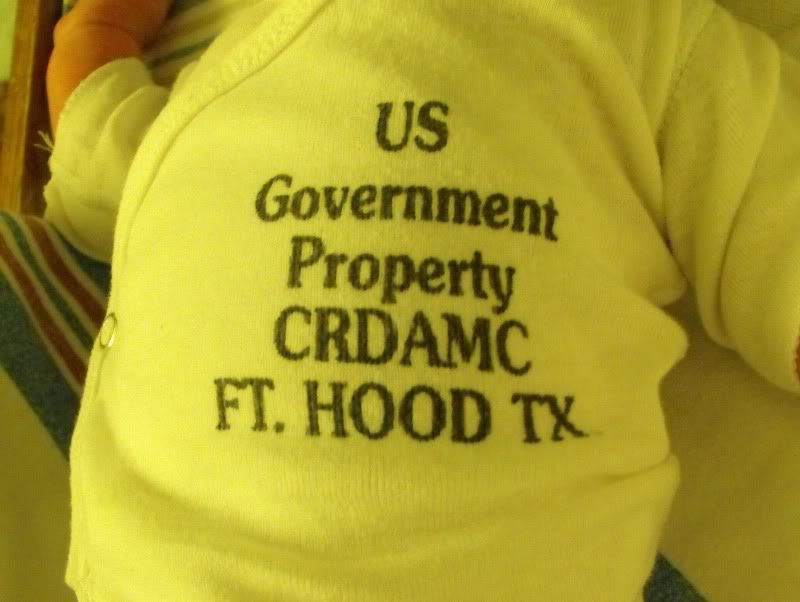
  5. This being an Army hospital, we were required to attend a "shaken baby" lecture and bring in the car seat we were going to use. There was nothing like that in Korea, where we held the baby in our lap during the ride home. The Army also felt a need to properly label everything they didn't want you to take. This, for example, wasn't just a funny T-shirt; they really meant it.
  6. The cultural differences were very apparent in the food that was served. In Korea, the new mothers don't get anything even remotely cihlled to eat or drink, and every meal features miyeokguk (미역국), the quintessential post-partum food. This time around, the fare was much better -- chicken marsala over spaghetti, beef brisket with a grilled cheese sandwich, etc. -- and drinks like iced tea were an option.
  7. Finally, this time around I get paternity leave. In Korea, there's no such thing -- I still had to work while she was in the hospital. I gotta tell you -- it's so much nicer to have ten days off to spend with the family to get better adjusted.
I'll go back to work on the 21st, but until then, I'm trying to balance the needs of my recovering wife, my newborn baby, and my "adjusting" son.

That's plenty enough.

Saturday, June 14, 2008

No, I'm not slacking off

If it seems like I haven’t been blogging much these days, it’s because I’ve been cleaning up, working out, and taking care of the baby.

SY and I are planning to move to her parents house on the 22nd, and there are so many things I would like to do that there just isn’t time to do them all. I read Aquariums of Pyongyang and The Coldest Winter, and have been going through old newspapers to see if there’s anything I want to keep.

I’ve been trying to wrap up finances so that I don’t have anything to worry about through the end of the year, and am recording a CD of me reading nursery rhymes so that SY can play while I’m gone. (Five months is a long time for a baby to remember.)

I’ve also got a ton of little things I’d like to do, but almost certainly will not have enough time. At this point, I figure the best thing I can do is make some notes for later….

Saturday, June 07, 2008

The Tale of Two Towels

Korean has two different words for “towel.” The 수건 (sugeon) is the towel you use for your hands or cleaning tables, while the 걸레 (gollae) is for things like cleaning your feet or the floor.

One of the interesting things about language and culture is the way the two interact – in a sense, you can’t understand one without also studying the other. Now, in this case the etymology is a bit beyond me, but being married to a Korean means there are practical implications in the difference.

For example, if I throw my bath towel on the floor to dry my feet when I get out of the shower, I get yelled at. If I use the wrong towel to wipe a table, I get yelled at. If I clean up a spill with whatever’s handy – you guessed it – I get yelled at.

I guess my point is, even though English doesn’t differentiate between types of towels (besides Mom and her “guest towels”), if you’re going to be married to someone from a different culture, it pays to be sensitive to these kinds of things.

Tuesday, May 20, 2008

Sightseeing by subway

Strange as that may sound, it’s possible in Seoul because the subway system isn’t always underground. And when you work six days a week, you have to make the most of your opportunities.

That's why I appreciate my camera’s optical zoom.

For instance, check out these pictures of the 63 Building I took while crossing the Han River (한강, 漢江) on Line 4. The first one isn’t all that great, but the second one is not bad.

It’s not exactly like going on a tour, but it’s better than nothing.

Saturday, May 10, 2008

무료 (無料) Big Mac

McDonald’s has a special deal these days: “Free Big Mac Tonight.” When you order a super-sized set, they give you a coupon for a free Big Mac. It sounds pretty good, until you look at the fine print:


You have to show up between 11pm and 4am to use it.

Either the corporate goons up in HQ were on drugs when they came up with this one, or this is one heck of a stingy promotion. How are you supposed to wake up in the middle of the night just to redeem the coupon?

Well, I for one was not going to let my fee Big Mac go unredeemed. So tonight, after I put the baby to sleep, I walked over the Micky D’s near my house and used my coupon.

Thought you were going to get away with a fast one, didn’t you? Ha! No way. To me, a free Big Mac is the most precious thing in Korea, and I’m definitely not going to let it pass me by.

Friday, May 02, 2008

"Shrimp fried rice" with shrimp and fried rice

Even though I'm now finishing my third year in Korea, there are still times when I'm really confused as to what's going on. My past two visits to Kim Ga Nae (김家내) have been a good example.

I remember, back before February when my hagwon paid for the teachers' dinners, that Kim Ga Nae made a really delicious shrimp fried rice (새우볶음밥) that I would order for what seemed like weeks at a time.

Seeing as how I hadn't had it in a while, I thought take some out and eat it at home. It wasn't on the menu, so I asked, in Korean, "Can you do shrimp fried rice?" / "새우볶음밥 할 수 있어요?" The lady seemed to say yes.


A while later, she came back and pointed to something else on the menu, the "오불덥밥", which at 5,000 won I assumed to mean that's how much she would charge me. I nodded and said, "That's OK." / "괜찮아요." When it came out, I paid for it and carried it home.

When I got it home, I opened it up and -- to my unpleasant surprise -- there was the "오불덥밥" beef dish. Grr! That wasn't what I asked for, but I accepted that it was my fault -- the lady had asked me and I'd said that was OK. Mea culpa. I ate it, and even though the rice wasn't friend, in all honestly it wasn't bad.

About a week later, I went back, and asked again -- to the same lady -- "Can you do shrimp fried rice?" Again, she said something to the effect of "yes." That part was pretty clear to me. But again, when I got it home, there was the beef dish.

So at this point I'm a little puzzled. I know for certain that I'd said it right, but I can't figure out why the lady would give me a different thing and not tell me. Maybe, in her mind, she was thinking, "This foreigner guy thinks he wants A, but I know what he's really talking about is B."

That would be annoying (I'm not an idiot) but at least it's not evil or malicious on her part. Still, before I go back a third time, I want to make sure things are clear that I want "shrimp fried rice" and not some beef dish. How can I explain this effectively?

I was joking with my wife a bit about this. Option 1 is to threaten the lady if she doesn't give me my shrimp fried rice. "If you give me that beef dish again, I'll kick your ***!" / 다시 오불덥밥 주시면, 마줄래!"

Option 2 is to order 새우볶음밥 just like last time. Then, before I take it out of the restaurant, I check it out to make sure it's the right thing. If it isn't, I throw it against the wall and, as it's sliding down, scream at the top of my lungs, "Does this look like shrimp rice to you!?!"

I don't know. Maybe it's just best to say it really slowly, and eat it there. If it's not right, I can just send it back.

"Excuse me, but I really wanted shrimp fried rice. Where's the shrimp?" / "실례하지만, 정말 새우볶음밥 원했어요. 새우 어디 있어요?"

Finally! Mussel & Muggle

Today, the wife and I took advantage of our last day with doumi to go out to a restaurant I'd been hassling her about since last year -- Mussel and Muggle.

I read about it in the September 15, 2007 Korea Herald, but because it's so far we could never find the time to go there.

Located near Shinchon station (시촌역) in the northwestern part of Seoul, it serves Belgian food in the form of moules et frites(mussels and fries) though not always with complete fidelity to the Belgian originals.

For example, they serve amazing dishes like moules au gratin, but accompany it with the kind of krinkle-cut fries your mom used to heat in the oven when you were a kid. And as is typical in Korea, "pasta" refers specifically to "spaghetti." Penne, linguini, and even macaroni go almost unheard of.

Still, they served a heated wine that was great, and their waffle dessert (while not a truly "Belgian waffle") was delicious. I had a great time, but then again, it might just have been because we haven been able to really "go out" in a while.

Here are some details, copied directly from #9 on this Korean blog:

머슬 앤 머글 / mussel & muggle

Address: Seodaemun-gu, Changcheon-dong 52-124
주소 : 서울시 서대문구 창천동 52-124

Phone / 전화번호 : 02-324-5919

Hours of Operation / 오픈시간 : 월~토 : 정오~오후 3시, 오후 5시~자정, 일 : 오후 5시~자정
Mon to Sat, noon to 3 and 5 to midnight, Sun. 5 to midnight

Prices / 휴무일 : 연중무휴 예산 : 10,000~20,000원 인기메뉴 : 믈 알라 또마뜨 9,000원, 믈 그라탱 9,500원 주차 : 불가능
Roughly $10 to $20 per person, with a little bit of a discout for lunch.

"Evil Dead Musical"? Are you serious!?!


Wow, I guess so....

Tuesday, April 15, 2008

Elections

In December, Koreans chose the new president. On April 9, they elected the National Assembly (국회의사당, 國會義社堂) representatives.

In Korea, the range of acceptable election practices has gotten tighter over the past two decades since the transition to a civilian government. Candidates are no longer getting away with things like buying meals or giving money for votes. Taking a picture of your ballot with a cell phone is also illegal, since it implies that you intend to show it to someone and get compensated.

In fact, the small town of Cheongdo (청도) in the southeastern province of Gyeongsangdo, has recently become a byword for a corruption because of a vote-buying in the December election. Nearly 6,000 people were involved, accounting for over 12 percent of the entire town's population. [Source] The media jumped all over the news, giving the town a lot of unwelcome publicity - a sign that such monkey business is no longer being tolerated.

Still, candidates can legally do some interesting things by U.S. standards. For example, it’s OK to drive through town in the back of a truck and broadcast messages on loudspeakers. A couple of times, I’ve had had my class disrupted by this, but wasn’t able to get a picture in time. Then, finally, I had seen one candidate near my in-law’s place.

However, despite the “structural” improvements to the electoral process, opinion writers complained that The Korean election was characterized by an almost complete lack of discussion about policy. Rather, candidates relied on personalism and party – who the candidates were and why they were the best qualified. As a result, it was all about what was on their resume rather than what they offered the Korean voter.

If that sounds familiar, I guess that it’s because it’s pretty similar to the U.S. Democratic primary. Clinton garners the strongest support from women and those over 60 – it’s not a big coincidence that she’s a woman and in that same age group is not much of a surprise. Nor is it big news that a key constituency for Obama is the African-American population. They’re both winning key demographics because of who they are, rather than what they offer.

So I guess if Korea’s elections – flawed as they are – are about on par with American standards, they must be doing OK. It's just too bad we can't represent a higher bar.

Thursday, March 27, 2008

Guardian

"I want a drink of water."

In a U.S. hospital, a nurse or some orderly would be the one to get it. In Korean hospitals, however, it's responsibility of the bohoja (보호자, 保護者). Literally, it means "guardian," though that sounds like the hospital might come under ninja attack or something. I'd probably call describe it as more of a "caretaker".

And that's my job these days, while SY is recovering. When the baby (let's call him "P")wakes up and wants to nurse, it's my job to pick him up from the nursery (which is just across the hallway), and bring him back. When SY wants to get up, it was my job to lift. When meals come, it's my job to set things up.

It was a little stressful at first, because P came earlier than we'd expected, and I couldn't get out of work any sooner than I'd scheduled. In fact, I'm sacrificing precious sleep just to write this post.

It's also a bit tough because I have to do some things that orderlies would do in the U.S. For example, when SY needed to be moved from the wheelie bed to the bed in her room, it was my job to take off my shoes, stand on the bed, grab one side of the sheet supporting her, and pull.

It's stressful, though I'm not sure who has more -- me, or SY, who had to translate this idea while still under anesthetic. It's not so much the words that are the problem ("Like this" is pretty easy vocabulary); it was the idea that this sort of thing is my job.

It'll get a lot easier after Sunday. My Sunday school lesson will be finished and my vacation will start, so I don't have to go to work in the evenings.

Friday, March 14, 2008

Weakening Won

Because of the likelihood of recession in the U.S., the dollar has been weakening, and there's a big rush to commodities (gold, oil, etc.) that is weakening it further. I thought that would be good for the won-dollar exchange rate, but that's not the case. In fact, the situation is the exact opposite of what I was expecting

This has made me quite cross.

After many years of the Korean won strengthening against the dollar, the past few months have seen a big drop in its value. Just today it hit a three year low.

Newspapers have been chocking it up to a flight from emerging markets. As U.S.-based investors face uncertainty in the global economy, they're divesting of their foreign holdings and repatriating their funds. That's a huge tide of money I have to swim against.

The 8 percent drop from its high water mark in November means it's costing me about 150,000 won ($150) more to send back my normal monthly remittance of $2,000.

The good news is that I can probably get by with just one more remittance before I move back to the U.S. in July and start getting a dollar-based salary (the Army pays in dollars, of course). And if I'm lucky, I'll be stationed in Korea, where I can then take advantage of the reversal in the won's progress.

"One man's tragedy is another man's fortune." Strange that they could both be me.

Wednesday, March 12, 2008

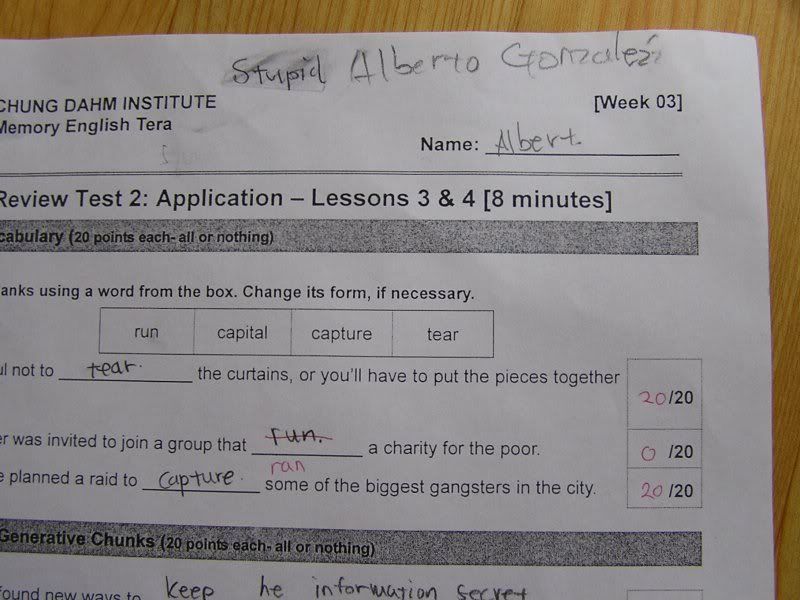
Albert and Alberto

I have this one kid named Albert in one of my classes. He’s a great student – he always does his homework, he’s pretty smart, and he’s really funny. He can sometimes be a bit of a punk, but to me this is not really a bad thing.

From time to time he’ll come up with some funny idea, like the time when he tried to memorize pi to 100 places, or another time when he made a full page list of impossibly silly Korean names (for example 꽦쀍쿜). When he showed it to me, he and I just about laughed ours heads off.

Albert is a regular grade school boy at heart -- he remains fixated on this one book we did a while back – Gross Body Facts. His favorite subject was, and remains, chunky vomit. What I say about that, though? I remember some of the stuff I came up with in grade school, and it’s really not much different.

Out of all the students at CDI, I've had him a surprising number of times. I had him in my Spring 2007 English Chip 4 class (my first term at CDI), then again in Fall 2007 in Memory English Giga. Now it’s Spring 2008 and he’s in my Memory English Tera class.

One day I was telling him about former U.S. Attorney General Alberto Gonzales. That day we had a few minutes of free time at the end of class, so I pulled up a YouTube montage of his "I don't recall" Senate testimony. The video shows his 70+ repetitions of the phrase.

Of course, the students didn't know what the whole thing was about, but they did understand the idea of a 모르쇠 (mo-reu-swe) -- a guy who who pretends to not know anything so as to avoid trouble (typically in a corruption case). [Source]


When the kids saw the video, they thought it was absolutely hilarious. Of course, now I have the problem of kids writing in "I don't recall" on their vocabulary tests, but it was worth it.

Albert, on the other hand, had this to say about the guy who ruined his name:

So to Mr. Gonzales, who may be lameting his demise in Washington, I have this comfort:
Worry not, for your name and deeds will forever be etched onto the minds and memories of my English students here in Korea. My student Albert, of course, will always recall you.

Friday, February 29, 2008

Winter Poem

My mom sent me some pictures of their back yard -- it's completely filled with thick snow. I was so envious.

It snowed here on the night before the 26th, and it was incredibly beautiful; I only wished I didn't have to work that morning so that I could enjoy it longer. It was that sticky kind of snow you only get when it's not too cold -- the kind that's perfect for making snowmen or taking pictures. Unfortunately, being this close to spring almost guarantees that it never lasts long. Sure enough, in this case it lasted barely two days -- so sad.

So I took some pictures on my way to work, wrote a poem, and made a presentation for my mom. I had a little trouble sending it to her -- my email service won't send EXE files -- so I had to upload it to my file host and send her the link.

Then I thought, "Well, it's already there. I might as well post it." So here you go:

Bryan's Winter Poem

It's converted from PowerPoint into an EXE file, so all you'd have to download it and double-click. Once it's finished, hit "Enter" a couple times and it'll take you back to your main screen.

Friday, February 22, 2008

Post-natal "hibernation"

In Korea, it’s customary for new mothers to rest for about a month or two after the birth. This “san-hu-jo-ri” (산후조리, 産後調理) translates literally as “post-natal care of health.” It varies in length by class and generation.

For noble families in the 19th century, it probably approached the ideal 100 days (백일, 百日). However, for SY’s mother, who had her children in the impoverished, post-war, agricultural Korean countryside, it lasted just one week. These days, it’s longer, but out of practicality it’s not often longer than two months.

There are lots of special rules and foods for mothers during this period. According to one schedule, simple showers are only allowed after the fourth day, with full showers permitted after six. Among the required foods are pumpkin (it absorbs water, decreasing bloating), gom-guk (곰국, made from beef marrow, it has a lot of protein), and seaweed soup (me-yeok-guk, 미역국, for the iodine).

Traditionally, the grandmother takes care of the mother while she recovers from the birth. These days that has become less possible, and people are more wealthy, so other measures have developed in the past twenty years.

For the very well-to-do, there is the “sanhujori-won” (산후조리원, 産後調理院), which is like a hotel for new mothers. Attendants not only take care of the mothers, they take care of the baby whenever it wakes up, allowing mothers full nights of rest. Of course, this is not cheap – a week runs about $1,000.

Those with less income can opt for a doumi (dō-oo-me), literally, an “assistant” who comes over to the house six days a week. (Strangely, in Korean it’s spelled 도우미, not “도움이.”) Typically, they run about $600 per week, though the government provides support for lower income families through the health care system.

That it’s through the health care system is key, because through a strange set of circumstances, SY and I qualify for two weeks of practically free government-sponsored doumi assistance.

From what I can tell, here’s how the system works:
  • Qualification for doumi assistance is based on one’s monthly health insurance premium, which varies according to one’s means.
  • When possible, one’s health insurance premium is based on income. Employers calculate the required premium based on an employee’s income, and they pay half. The employee pays the other half. Of course, those with high incomes have to pay a high premium, and those with low incomes pay a low premium.
  • To prevent the non-working rich from getting disproportionately low rates, districts are responsible for determining premia for the self-employed or jobless. A district will typically look at significant assets such a registered car or the assessed value of a house, so a “jobless” person with a Porshe and a million-dollar would still have to pay a high premium.
Now, as it applies to us, it works like this:
  • My school classifies me as an “independent contractor,” so they don’t pay my health insurance premium. Since my premium doesn’t get determined by income, it’s up to the district to set the rate.
  • When the district looks at our case, they see we have no significant assets – neither a house nor a car. They then determine that we are not rich, nor anywhere close, and set the lowest premium for us.
  • When determining our doumi assistance, the people in the health care system look at our insurance premium (the lowest possible) and allow the maximum benefit – two weeks.
So it’s strange, but that’s my best guess about how it works. I suppose, since my school withholds income taxes, that it’s possible for the government could look up my income via my registration ID number, but for some reason the district office either cannot or doesn’t want to.

That’s fine with us – we welcome any assistance the government offers – but there’s another question that has come up as a result: where to we put all these people? The doumi work from 9 to 6, six days a week. With my atypical work schedule, I work in the early mornings and evenings, but not during the day. I would get home about an hour after the doumi arrives, and stay for about five hours before going to the evening job.

That’s five hours with the four of us (SY, the baby, the doumi, and me) packed into our studio apartment, and me doing nothing but trying to stay out of the way. (That’s got to be a little awkward.) Then, after the doumi leaves, and SY is by herself for another four.

It seems best for SY to do about a month of her sanhujori at her parents’ house, and then return during to our apartment after that. The doumi will be with her during the day, and her parents during the evening. After class, I can spend the rest of the morning with them, and then head home for lunch before walking to work at the school.

Only two more months...
Friday, February 15, 2008

Recycling in East Asia

East Asian countries (Korea, Japan, Taiwan, and China) seem to have a good grip on the "Reduce, Reuse, Recycle" concept. My own experience in Korea mirrors two stories I've read.

First, China recently banned free plastic bags, forcing consumers to pay for bags at the grocery store. [Source] If that sounds a bit authoritarian, consider that Korea does the same, and that it's only about 5 cents per bag. It's a subtle, but effective way to reduce the amount of bags given out.

A few months ago, I got a durable, reusable, collapsable orange bag with a box of Frosted Flakes, and have been using it ever since. Compare that with the infinite supply of bags withins bags that I kept in Hawaii, and I think the Asian system is better -- there's an incentive to reuse.

Second, I read a Washington Post story about Taipei's recycling system by Fulbright scholar Julia Ross. Like Taiwan, Korea requires residents to sort their trash into paper, plastic, cans, food waste, and general waste. And I'm surprised by how much is recyclable -- even the plastic wrapper from an ice cream bar. You may think that's a bit much, but there's no room for being lazy -- I've heard many stories from fellow English teachers getting yelled by their landlords for getting things wrong.

Korea also requires that general, unrecycleable trash be thrown out using specially marked trash bags. These bags cost much more than they are worth, giving consumers another reason to minimize waste.

To illustrate how extensive and sophisticated the system is, I took a picture of the garbage cans at the McDonald's in the COEX shopping center.

On the right hand side is the paper waste (일반쓰래기). The tray liner and paper containers go there. In the center is the lid for the food waste (음식물). If you don't finish your Big Mac, you put that in there. Liquid waste, like the ice from your drink, goes in the drain above the food waste, while the plastice straw and top go in the bin above the general waste. Cups go in the spot behind the trays.

Thursday, February 14, 2008

Fire at Namdaemun

This week a disaffected arsonist burned down Sungnyemun (숭례문, 崇禮門) this past week. Also known as Namdaemun (남대문, 南大門, "Great South Gate"), which was considered Korea's greatest national treasure. Having stood for 610 years, it had survived the 1592 Japanese invasion, the entire colonial period, and the Korean War. In the end, it took only one Korean citizen to destroy it.

It's hard to overstate its effect on the Korean psyche (you can imagine how the U.S. would react if the Statue of Liberty had been destroyed). Though reconstruction efforts can rebuild the gate, it will take about three years and $20 million, and even then I'm sure people won't feel the same way about it.

Here's a picture of how it looked.

It was special in part because it marked the southern limit of the old walled city, though in today's Seoul it was right about in the middle. A traffic circle surrounded it, patrolled by three security guards by day and security cameras at night.

The arsonist, a 69 year-old man surnamed Chae, was angry because he had lost his land an eminent domain case ten years ago and felt the government didn't compensate him well enough. According to his confession to police, and the CCTV cameras, he set up a ladder to the second level, sprayed an area with light fluid, and then threw in a pair of lighters. He left on foot.

Firefighters arrived and tried to put out the blaze, but hesitated out of fear that a full effort would damage the structure. Police are investigating numerous parties for negligence (read: looking for a scapegoat). Chae had set a fire at Changgyeonggung (창경궁) before, and served jail time for that.

This isn't the first time a Korean citizen has set fire to a national monument. In May 2006, a drunk arsonist set fire to a part of Hwaseong (화성, 화성), destroying its western command post. [Source]

In my opinion, it's sad, not just because of the destruction, but because in the future there will have to be all kinds of protections built up to protect Korea's national monuments from destruction -- at Korean hands.

Wednesday, February 13, 2008

Lunar New Year

Last week was the Seollal (설날) here in Korea, one of the two most imporant holidays in East Asia. Businesses close for at least three days (this year, Wednesday through Friday), sometimes the whole week.

Though my school made us work on Wednesday from 10 to 1pm, they gave us Saturday off, which I thought was better anyway. Wednesday afternoon SY and I went to her parents' house and ate dinner with the whole family -- nieces, nephews, brothers, and sisters-in-law.

Thursday was similar -- we went to the parents' house for breakfast, hung out for lunch, and then went home. There was a ceremony in the early morning, but that was before we'd gotten there.

For Seollal, the younger generations bow (jeol 절 style, with face and hands to the floor, in a ceremony called "새배") to the older generations. In return they get money (usually about 5 or 10 dollars). Kids like this deal; socially it's kind of like Christmas, but they get money instead of presents. I did my bow to her parents, and then my 2 nieces and 4 nephews bowed to me (all at the same time).

Those dinners are usually a bit stressful for me, since I don't know what's going on and no one really talks to me. Mostly I just sit there and keep from getting too bored. We eat traditional Korean holiday food (like ddeokguk, 떡국) and then SY and I go home.

One of the things I was surprised by this year were the little fiddler crabs SY's mother served. They were only about an inch and a half across:

From what I saw, the way to eat them is to put the whole body in your mouth, crunch it up, suck out what meat you can, then spit out the shells. Eat the big claw separately.

Friday and Saturday I caught up on rest. Later, we went out and saw the movie Happily Never After. All in all, a nice weekend.

Wednesday, January 16, 2008

Breaking a campaign pledge, Korean style

South Korean president-elect Lee Myung-Bak (이명박, 李明博) hasn't even been sworn in, but he's already dumped his central campaign pledge: the 747 plan. [Source]

The plan called for Korea to maintain 7 percent growth, attain a per-capita GDP of $40,000, and become the world's 7th largest economy. Currently, growth is a bit under 5 percent, the per capita GDP is about $20,000, and the economy is the world's 11th largest.

On Monday, he held a press conference and downgraded growth expectations to 6 percent.

I'm not surprised. The only way to get 7 percent growth out of Korea is with 5 percent inflation. The campaign pledge was just a gimmick. (Imagine Korea as a 747, flying high, high up in the sky!)

Even with 7 percent growth, the second part of the plan still would have been impossible. Getting from $20,000 to $40,000 in five years requires 14-15 percent annual growth (some quick Rule of 72 stuff there). That's just plain silly -- it would be faster than China has ever grown, in a country that is already at an unprecedented stage in its development.

I'm not sure which one's worse: blowing off the whole thing right after the election, or the American way of at least waiting until half-way through the term ("Read my lips: No new taxes").

Tuesday, January 01, 2008

Saturday, December 22, 2007

The Secret Message

I went to the bank last week, and saw this box of wet tissues. It made me wonder, "What's the secret message?"

My guess is, "Your hands are filthy because they've been touching money. WASH THEM NOW!"