Showing posts with label Heroes. Show all posts

Saturday, February 19, 2022

Hero #20 Gail Halvorsen

In June 1945, COL Frank Howley set the tone for the U.S. Army's occupation of Berlin. "He thought of the Germans he would rule over in Berlin with a cold loathing instead of sympathy. His brother had been crippled fighting Germans during World War I," and many of his friends had perished during World War II. [Source]

To Howley, the residents of Berlin deserved to suffer. And that, they did. 125,000 of Berlin's civilians died as the Russians took the city from the east. Those that survived endured "an orgy of rape and rage beyond the bounds of human imagination. Over the course of ten days, about 130,000 women were raped -- and most were violated repeatedly by various soldiers." It was so pervasive that "Doctors in 1945 would report that one of Berlin's children's favorite games was 'rape.'" Upon seeing a man in uniform, "they would start screaming hysterically," and seeing a plane overhead could send them into a panic.

The 16th Constabulary Squadron established police operations in the American Sector in 1946, but they most assuredly were not there to make friends. As the full horror of the Holocaust came to light, they were there to make sure "the German will not pick up his shooting iron and start throwing lead and lies at an unsuspecting world once more." American troops were instructed as they entered Germany: "In heart, body, and spirit, every German is Hitler," and "Don't make friends with Hitler." Neither were military personnel permitted to share their rations. Most Berlin residents subsisted on 1000 calories per day, and were left to scrounge through soldiers' food waste to augment their diets.

So when the Soviets closed the roads around Berlin's western zones in spring 1948, few felt that the residents of western Berlin were worth risking war with the Soviet Union. Although President Truman committed to resupplying the city by air (beginning the Berlin Airlift), Berliners were still "a ruined, poverty-stricken, brutalized people, with little to eat, everything to fear, nothing to hope for."

Lt. Gail Halvorsen helped change that. As a pilot during the Berlin Airlift, he took a moment to talk with a group of children near the Templehof airfield, and shared the sticks of gum that he had in his pocket. Judging from their reaction, Halvorsen concluded that this was the first time any of them had ever had a piece of candy.

The next day -- July 20, 1948 -- Halvorsen concocted a plan. Using three handkerchiefs and his weekly ration of gun and candy from the post exchange, Halvorsen and his crew parachute-dropped three bundles of sweets from their plane during their runway approach. He hoped it would be discreet enough that his crew wouldn't get in trouble for it.

In subsequent weeks, Halvorsen's crew would repeat their secret mission, which caused the crowd of children to grow. Eventually, the crowds grew so big that reporters took notice. "Soon mothers and the few fathers joined their children. More than a thousand Berliners started to stand outside Templehof every day. On warm days, the number would reach 10,000."

The "Schokoladen Flieger" (Chocolate Flyer) became a public relations coup, and changed the tone of the Berlin Airlift. For supplying the residents of Berlin during the Soviet blockade, Germans appreciated the Americans, but still "felt like they were pawns in a global power play." What Halvorsen's actions did -- his consideration of their children -- communicated to Berliners a sense of value and dignity. For the first time, Germans thought of Americans as "the good guys."

"When a C-47 crashed near Templehof, killing the two American lieutenants on board, residents set up a plaque commemorating the loss. 'Once we were enemies yet you now gave your lives for us. We are now doubly in your debt.'"

Gail Halvorsen retired after 30 years of service in the Air Force. Decades later, he attended Berlin's 50th anniversary commemorations of the Airlift in 1998. Berliners brought their children and grandchildren to the event, and "sixty year-old men broke down as they told him what a parachute that fell to their feet as they walked through ruined streets meant to them as children."

Sadly, Gail Halvorsen passed away today at the age of 101. [Source] For his role in the Berlin Airlift, and the impact he had on my grandfather (who served in the 16th Constabulary), I will never forget him.

Wednesday, April 21, 2021

Because that's what heroes do.

This man's name was was Charles Lightoller. He was 66 years-old when at the time of the Dunkirk evacuation. His experience only convinces me further that Jack's death was a suicide. (If this reference is lost on future generations, watch the 1997 movie Titanic.)

Nevermind. Just watch this.

Monday, March 22, 2021

Hero #19 Bob Fletcher

In early 1942, the U.S. government interned 120,000 Japanese-Americans because of their ancestry. Among them were several of Bob Fletcher’s neighbors.
He arranged to take care of their (combined) 90 acres of farmland while they were gone. He worked 18-hours days, paid their bills from the proceeds, and lived in one of the tenement bunkhouses rather than their homes. Although the three families offered him all of the profits from his efforts, he kept only half. Before the families came back, his wife even cleaned their houses.

Other white farmers harassed Fletcher his compassion. Special interests used the war as an excuse to drive the more productive Japanese-American farmers out of business. [Source] I see such conduct as shameful.

To me, Bob Fletcher stands out as a person who valued integrity, honesty, and humanity. Those were rare qualities then, just as they are now.

Fletcher died in 2013 at the age of 101. Said Doris Takeda, who was 12 years-old when she and her family were interned in Arkansas:

"He saved us." [Source]

Monday, June 04, 2018

Hero #17 Jack Swigert

"I believe God measures your life. He puts you on Earth, gives you talents and certain opportunities, and, I think, you're going to be called to account for those opportunities."
 -Jack Swigert, U.S. astronaut and congressman-elect. [Source]

Jack Swigert was played by Kevin Bacon in the 1995 movie Apollo XIII. He died of lymphoma in 1983, shortly before assuming office.

This photo was taken in the Denver airport.

Friday, September 15, 2017

Hero #16 Simone Veil (#78651)

The Economist wrote an excellent obituary on French stateswoman Simone Veil in its July 8th issue. The Holocaust survivor passed away on June 30th, at age 89 -- just a few weeks before my grandfather (and at the same age). French president Emmanuel Macron called her life an exemplary inspiration. According to a statement,
"Her uncompromising humanism, wrought by the horror of the camps, made her the constant ally of the weakest, and the resolute enemy of any political compromise with the extreme right." [Source]
Veil grew up in Nice as one of four children. In 1944, just a few days after taking the baccalaureate exam, she -- along with her mother and a sister -- were sent to the Auschwitz concentration camp. She never saw her father or brother again, and her mother died of typhus a few weeks before the April 15, 1945 liberation of the camp.

After the war, Veil trained as a lawyer, rose in political stature, and as health minister in 1974 brought women's right to the forefront of debate in the National Assembly.

Challenged to refute any moral equivalency between the Holocaust and abortion, Veil replied:
“I say this with total conviction: Abortion should stay an exception, the last resort for desperate situations. How, you may ask, can we tolerate it without its losing the character of an exception — without it seeming as though society encourages it? I will share a conviction of women, and I apologize for doing it in front of this assembly comprised almost exclusively of men: No woman resorts to abortion lightheartedly.”
Veil will be curried in the Paris Pantheon, alongside Victor Hugo and Voltaire, a distinct honor. Earlier, she was also granted the distinction of membership in the Academie Française, which included the customary ceremonial sword. It bore three engravings:
  • Liberté, Egalité, Fraternité (the French Republic's motto)
  • the European Union’s Unie dans la diversité,
  • and 78651, the number tattooed on her left forearm.

Tuesday, August 24, 2010

Hero #15 Robert Schumann

Robert Schuman was born in the fault line of the French-German conflict during the late 19th Century. His father was French from Lorraine, but became a German citizen when the area fell under German control following the Franco-Prussian War. Schuman's mother was from Luxembourg, but took German citizenship after her marriage. Though he learned French at school, he spoke it throughout his life with a distinct accent; he was more fluent in German.
He went to high school in Luxembourg, but attended university in Metz, and went on to receive a law degree. Afterward, he became a lawyer and worked for the Metz city council. After World War I, Lorraine and Alsace reverted to France after nearly 50 years of German rule, and he became a French citizen.

In 1940, Schuman was selected -- two months before the Nazi invasion -- to be part of Paul Reynard's wartime government. After France fell, Schuman was captured for "acts of resistance," interrogated by the Gestapo, and almost sent to Dachau.

Instead, he escaped in 1942 and rejoined the French Resistance. At a time when the Reich was at the peak of its power, he spoke of the inevitability of its eventual defeat; even after the Free Zone fell he was convinced that a Franco-German and even a wider European reconciliation would happen after the war.

That was, in fact, what took place, due in part to his influence. As Finance Minister, Prime Minister, and Foreign Minister, he was in a unique position to set the tone for intra-European relations. He helped guide the post-war political scene toward economic and political unity, starting with the European Assembly and the European Coal and Steel Community. He also supported membership in NATO.

Schuman dreamed of a united Europe -- not one under the domination of one dynasty, nation, or personality -- but by such shared values as democracy and human rights.

"We are carrying out a great experiment, the fulfillment of the same recurrent dream that for ten centuries has revisited the peoples of Europe: creating between them an organization putting an end to war and guaranteeing an eternal peace. The Roman church of the Middle Ages failed finally in its attempts that were inspired by humane and human preoccupations. Another idea, that of a world empire constituted under the auspices of German emperors was less disinterested; it already relied on the unacceptable pretensions of a ‘Führertum’ (domination by dictatorship) whose 'charms' we have all experienced." -- May 16, 1949

His courageous dream of a forward-looking Europe differed from its greatest figures of the past. The Merovingians, the popes, the Habsburgs, the nationalists, and the demagogues all pursued a self-centered kind of unity, and all of them failed with time. Instead, it took a modest, celibate, and deeply relgious man to alter the course of European unity.

For his vision, bravery, forgiveness, and multicultural identity, Robert Schuman is today considered the Father of the European Union.

Hero #14 1LT Christopher Dean

In 2004, a patrol from the 1st Cavalry Division was ambushed in Sadr City and 19 Soldiers were isolated and surrounded. 1LT Christopher Dean rolled out immediately with his quick reaction force of four M1A1 tanks.

According to the narrative that accompanied his Silver Star, First Lieutenant Dean fought two separate but continuous actions over the period of four hours in densely populated and constricted Sadr City with no dismounted support.

First Lieutenant Dean led an initial platoon attack to relieve the patrol which had suffered one killed and four wounded. Dean's attack inflicted grievous casualties on Mahdi Army elements in the center of the city in an intense action during which First Lieutenant Dean's platoon lost one soldier and two wounded. Dean himself was one of the wounded.

Despite wounds to his neck and left arm and after the tank's .50 caliber machine gun had been destroyed by enemy fire, Dean fought with his M4 from the tank's open hatch, personally destroying enemy troops within 15 meters of his tank. He then consolidated his platoon with arriving elements of the patrol and prepared the company for an attack 7 kilometers through urban terrain.

First Lieutenant Dean fought the entire subsequent attack out of the hatch in the forward-most tank during more than three hours of constant fighting. He assisted the company commander with recommendations relative to tactical employment of tanks and weapons systems while fighting and as his tank was hit by a large volume of small arms fire and several RPGs, two of which detonated.

First Lieutenant Dean organized a defense upon arrival at the isolated patrol's location. He dismounted his tank without regards for his personal safety in defense of the casualty evacuation and ensured accountability of all personnel from both his unit and the infantry platoon that his group was evacuating.

First Lieutenant Dean's leadership ensured the success of the company mission to evacuate 19 infantrymen who were isolated and surrounded by the enemy. First Lieutenant Dean's exceptional bravery while under intense fire during a four-hour attack despite wounds is in the highest traditions the United States Army. [Source]

Tuesday, June 02, 2009

Hero #13 Frances Perkins

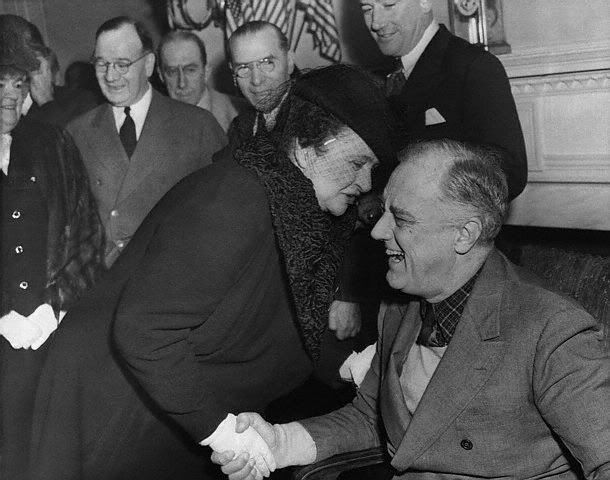
The subject of a new biography, The Woman Behind the New Deal, Frances Perkins served as Franklin D. Roosevelt's Labor Secretary from 1933 to 1945. A leading reformer in protecting the health, safety, and rights of workers, she found her calling in life at age 31 when she witness the Triangle Shirtwaist Fire of 1911.

(146 sweatshop workers, mostly immigrant women, were killed in a fire that forced many to jump to their deaths from a high floor. At the ensuing trial, the owners were exonerated.)

She began working for FDR in 1928 while he was governor of New York, and was appointed the first female Cabinet Secretary after he became president. Many hallmarks of employment we recognize today -- Social Security, the 40-hour workweek, child labor laws, and unemployment insurance -- can be attributed to her influence.

Perkins was completely selfless. In order to put her male coworkers more at ease, she adopted the role of the dowdy matron. She took care of her bipolar husband and daughter and provided for their care from her government salary. She wasn't interested in using her position for fame or power. She sincerely wanted to help people.

Sunday, February 22, 2009

Hero #12 Irene Morgan

February is Black History Month

In 1944, eleven years before the more famous Rosa Parks, Irene Morgan boarded a Baltimore-bound bus in Virginia and sat in the "colored" section. The mother of two, she had been ill and was scheduled to see a doctor after arriving.

When a white couple got on and needed seats, the bus driver ordered Morgan and her seatmate to move farther back. She refused. When a sheriff came to remove her from the bus, she resisted, kicking him in the groin and unsuccessfully struggled with the deputy sheriff.

He succeeded in dragging her off and she was charged with both resisting arrest and violating Virginia's segregation law. She pleaded guilty to the first charge and paid the $100 fine, but she refused to pay the $10 fine for the second charge.

She fought her way through the appeals process and reached the Supreme Court in 1946. In a 6-1 decision, the court accepted Thurgood Marshall's argument that Virginia's segregation was a violation of the interstate commerce clause.

Irene Morgan passed away on August 10, 2007 at the age of 90.

Friday, February 29, 2008

Hero #11 Young-Oak Kim (김영옥)

During World War II, Japanese-Americans on the U.S. Mainland were interned in relocation camps because of misplaced fear about their loyalties. In spite of this, nisei (二世) volunteer Japanese-Americans formed the 100th Infantry Battalion (as well as the 442nd Regimental Combat Team) and fought in seven major campaigns in Europe. Their experience is chronicled in the 1951 movie, “Go For Broke!”

What the movie leaves out is that their commander wasn’t white or even a nisei. He was an isae (이세, 二世), a second-generation Korean American. And while the movie that left him out was showing in the U.S., he was off fighting again – in the Korean War.

U.S. Army Colonel Young-Oak Kim was born in Los Angeles in 1919. He tried to join the Army after World War II broke out, but was turned away. After Congress passed a law allowing the Army to draft Asian-Americans, he was drafted in January 1942. After about half a year, he began OCS. On graduation in January 1943, he was assigned to the 100th Infantry Battalion.

After distinguishing himself in the Battles of Anzio, Belvedere, and Pisa in Italy, and again in France at the battles of Bruyere and Biffontaine, he was severly wounded. He was shipped back to the U.S. for six months to recover, but the war in Europe soon ended. Other acts of distinction

Later, during the Korean War, he served as Chief Intelligence Officer in the 31st Infantry, 7th Infantry Division. After being promoted by William J. McCaffrey, he had the distinction of being the first-ever U.S. field battalion commander of Asian descent.

Kim's accomplishments extended beyond the battlefield. During the war, he opened an orphanage and took care of hundreds of war orphans. After retiring in 1972, he continued to help poor orphans and Korean adoptees. [Source]

For his contributions in Europe and Asia, Kim received the Medal of Honor, Italy’s Cross of Valor, and the French Legion of Honor. In 2005, Korea also awarded him the Taeguk Medal of Honor. In his memory, the University of California at Riverside has decided to dedicate a research center for Korean-American studies.

Young-Oak Kim passed away in late 2005.

Sunday, February 24, 2008

Hero #10 Elizabeth Eckford

I saw this picture in one of my class books, and read about the story.

Just one month shy of her sixteenth birthday, Elizabeth Eckford became known across the United States as one of the "Little Rock Nine," black students who were chosen to attend the otherwise all-white Central High School. The picture, taken on September 4, 1957, shows Haley Bryan-Massery behind Eckford.

When recounting the top events of the 1997, an Arkansas newspaper printed this on January 1, 1998:

One of the fascinating stories to come out of the reunion was the apology that Hazel Bryan Massery made to Elizabeth Eckford for a terrible moment caught forever by the camera. That 40-year-old picture of hate assailing grace--which had gnawed at Ms. Massery for decades-can now be wiped clean, and replaced by a snapshot of two friends. The apology came from the real Hazel Bryan Massery, the decent woman who had been hidden all those years by a fleeting image. And the graceful acceptance of that apology was but another act of dignity in the life of Elizabeth Eckford. [Source]
That desegregation was such a painful process remains a blight on American history. Yet Eckford, through both her grace and forgiveness, reminds me that no stain need last forever.

Follow this link for a timeline of the Central High School's desegregation.

Tuesday, January 22, 2008

Hero #9 Tibor Rubin

Born in Hungary in 1929, Tibor "Ted" Rubin and his family were sent to the Mauthausen concentration camp at age 13. Upon liberation of the camp by the U.S. Army on May 5, 1945, Rubin vowed that if he ever made it to America, he would show his appreciation by enlisting in the U.S. Army. He got his wish in 1948.

Though still not a citizen, he kept his word and joined the First Cavalry Division. Seven months later, following the outbreak of the Korean War, he was sent to Korea. 1

Rubin's superior was an anti-Semite who "volunteered" Rubin for the most dangerous missions, hoping to get him killed. One night, during a retreat back to the Pusan Perimeter, Rubin was assigned to hold a hill that was essential his regiment's safe withdrawal. In spite of the danger, he defended the hill for 24 hours against an overwhelming number of North Korean forces.2

On October 30, 1950, during the Chinese counterattack, Rubin stayed behind to man a machine gun -- where three men had already fallen -- so the 3rd regiment could escape. After running out of ammunition, he was captured by Chinese forces and taken to a prisoner of war camp. Offered a chance to repatriate to by then-Communist Hungary, he refused. Instead, he dedicated himself to helping his fellow prisoners, risking death by sneaking out at night and stealing food for the sick and dying. [Ibid]

Though he was recommended for the Medal of Honor three times by two commanding officers, his first sergeant ignored orders to process the paperwork. It was only after the passage of the Leonard Kravitz Jewish War Veterans Act of 2001 that a review of 138 Jewish war veterans' records were reexamined.3 President George W. Bush personally awarded him the Medal of Honor on September 23, 2005.

When asked if he felt any animosity about being overlooked and discriminated against for 54 years, he answered,

"I don't hate nobody because life is so short. If you feel hate for your fellow man ... you'll only hurt yourself. You hate yourself inside and accomplish nothing. I have nothing against the Germans - they killed 98 percent of my family - or the North Koreans and nothing against the Chinese. Because I do believe in God. He is the only one that's going to take care of it." 4

Among his heroes, Rubin talked about his family.

"My father was a hero. My mother, Rosa, was always a hero. She taught me that we are all brothers and sisters. She had so many good qualities. She taught me to treat people the way you want to be treated....

My little sister Ilonka was in Auschwitz and taken into the gas chamber, and my mother went along. She didn't have to but she couldn't leave the little one. I think about what my mother did, and I would have done the same." [Ibid]
1 Army citation page
2 White House award ceremony
3 JewishJournal.com
4 Orange County Register

Monday, January 21, 2008

Hero #8 Michael P Murphy

In June 28, 2005, Navy Lt. Michael P. Murphy led a four-man SEAL operation in Afghanistan. When the team came under attack by a force of about fifty men, they attempted to extricate themselves from a three-sided assault.

When this proved impossible, the team's communication petty officer, Danny Dietz attempted to place a call back to headquarters. Before he was able, he was shot in the hand, and later killed.

Realizing that their only chance of getting out alive depended on reinforcements, Murphy then took out his mobile phone and, in the words of the only surviving team member Marcus Luttrell,

"... walked to open ground. He walked until he was more or less in the center, gunfire all around him, and he sat on a small rock and began punching in the numbers to HQ... I could hear him talking. 'My men are taking heavy fire ... we’re getting picked apart. My guys are dying out here ... we need help.'

And right then Mikey took a bullet straight in the back. I saw the blood spurt from his chest. He slumped forward, dropping his phone and his rifle. But then he braced himself, grabbed them both, sat upright again, and once more put the phone to his ear."
According to Luttrell, Murphy then said, “Roger that, sir. Thank you.” The lieutenant continued to train fire on the enemy fighters until he was mortally wounded. Source

For his gallantry in the face of death, Michael P. Murphy was posthumously awarded the Medal of Honor by President George W. Bush in a ceremony on October 22, 2007. He is, thus far, the only recipient of the Medal of Honor for actions the Afghanistan theater.

The story continues, in an even greater tragedy. Though the cavalry was sent, it never arrived, so to speak. In the biggest loss of life for special warfare since World War II, the MH-47 Chinook helicopter sent to relieve Murphy's team was shot down by a rocket propelled grenade, killing all 16 men aboard.

Luttrell survived the engagement, but with a bullet wound to one leg, shrapnel embedded in both legs, and three vertebrae cracked, the situation was grim. Though dehydrated, he travelled seven miles on foot and evaded the enemy for nearly a day.

Surprisingly, local nationals came to his aid, carrying him to a nearby village where they kept him for three days. Source. He documented the events in his book "Lone Survivor."

Thursday, August 02, 2007

Hero #7 James J. Braddock

I recently heard a church lesson based on the life of James J. Braddock, one of the great inspirational stories of the 1930s.

Clips from the movie "Cinderella Man," were used as examples of how to have good marriage and family relationships. The movie starring Russell Crowe and Renee Zellwegger, is really inspiring -- I really recommend it.

More impressive is the movie's consistency in matching real life. With the exception of Max Baer's personality, just about everything is the movie is consistent with what happened in real life.

Plus, Braddock had a life after he finished boxing. He fought in World War II and helped build the Verrazano Bridge in New York City.

One of the themes from the movie is "there's always someone worse off than we are." That was really important for me. I have a tendency to regret mistakes and complain rather than see all the positives in my life.

Tuesday, May 01, 2007

Hero #6 Jessica Lynch

Jessica Lynch became a hero to a lot of people in March 2003, when the military reported the heroic struggle of her supply convoy against capture by Iraqi forces. A week later, a filmed rescue operation freed her from an Iraqi hospital.

She recently spoke at a hearing of the House Committee on Oversight and Government Reform, and explained why she was not a hero[ine] at all. She was unconscious when captured.

However, Lynch is not a hero for me because of her experience. I like her faith in the American people, and respect for accuracy over acclaim: "The bottom line is, the American people are capable of determining their own ideals for heroes, and they don't need to be told elaborate lies."

[Source]

Thursday, April 26, 2007

Hero #5 Joseph Beyrle

Joseph Beyrle might say he didn't do anything more than anyone else would have done in his circumstances, but his circumstances were pretty extraordinary.

Joseph Beyrle had the distinction of being the only World War II soldier to fight for both the U.S. and the Soviet Union. After graduating high school in 1942, Joseph Beyrle turned down a scholarship at Notre Dame in order to enlist in the army. As a paratrooper, he was captured in France shortly after D-Day (when he blew up a power station) and was taken to a POW camp in eastern Germany.

He attempted to escape twice and failed. In January 1945 he tried a third time, and succeeded in finding a Russian tank brigade. As first the Soviets were skeptical he was American, but he convinced them by helping blow up some trees that were blocking their advance. (Apparently he was pretty good at demolitions....)

Later, after helping liberate his old POW camp, he was wounded in an attack by German dive bombers, and taken to a field hospital. While he recovered, top Russian general Georgy Zhukov paid a visit, and granted him travel papers that allowed him to go to the U.S. embassy in Moscow. (Of course, by that time he'd been declared dead, and had trouble convincing embassy officials otherwise. Eventually he convinced them to fingerprint him for confirmation.)

I first heard about Beyrle in May 2004, when I read in the Korea Times about his visit to Moscow for the Victory Day celebrations. At that time his son, John Beyrle, held the position of deputy ambassador (charge d'affaires?) at the embassy.

Joseph Beryle chronicled his experience in the book The Simple Sounds of Freedom (aka Behind Hitler's Lines). He passed away in late 2004.

To me, Beyrle is admirable for a couple of reasons. First, he sacrificed his chance to go to college in order to serve his country. Second, he continued to try escaping even after taking so many beatings -- I might have just given up. Finally, he showed incredible persistence in his dealings with U.S. diplomats.

If only for that last reason, he deserves to be on this blog.

[Source]

Wednesday, April 25, 2007

Hero #4 John Marshall Harlan

This post summarizes the second section of the book I just reviewed. To highlight why I think he's such a respectable guy, I'm contrasting him against fellow justice Oliver Wendell Holmes.

Who would have thought that former slaveowner John Marshall Harlan would be more respected by history than former abolitionist Oliver Wendell Holmes? Both fought in the Civil War, but while Holmes developed a nihilistic attitude, Harlan became the Court’s greatest proponent of civil rights.

Holmes, unfortunately, was the man of his day, and was celebrated as “a democratic visionary.” He hated all forms of moral certainty, and refused to strike down Jim Crow laws that – by common understanding – clearly contradicted the Reconstruction amendments. He viewed politics as war and life as a Darwinian struggle for power – he felt it belonged to those who could amass it. In the 1920s, he upheld eugenic sterilization laws directed at the mentally disabled.

Harlan, on the other hand, “was dismissed as a moralizing eccentric.” Harlan was the sole dissenting vote when the Court struck down the Civil Rights Act of 1875. When the Spanish American War brought foreign territories under the U.S. flag, he argued (unsuccessfully) that the Constitution follows it, an opinion that resonates today with the critics of the Guantanamo Bay prison.

According to this account, Harlan felt comfortable intermingling with people of various ethnicities, and held middle class values.

He passed away in 1911. Two generations later, his grandson (with the same name) also became a Supreme Court justice.

Saturday, April 21, 2007

Hero #3 Khaled Abdelwahhab

The Nazi regime's policy to exterminate European Jews is well known and documented, but few realize the Holocaust also extended into North Africa. After France surrendered, its successor state (Vichy France) enforced Nazi-style laws, and surrendered many Jews to Nazis.

Robert Satloff's book "Among the Righteous" includes one story of an Arab who sheltered North African Jews during the Holocaust.

In the Tunisian town of Mahdia, a family named Boukris took refuge in an olive-press factory, with other Jewish families. One day, an Arab man named Khaled Abdelwahhab decided to help.
"That night, he went to the olive press factory, banged at the door, and told everyone there to pack their bags and come with him," said Robert Satloff." For the rest of the night, he ferried 24 people back and forth in his car to a farm that he owned 20 kilometers away." [Source]

After the war, according to the account of the late Anny Boukris, Khaled Abdelwahhab was a frequent honored guest at her family's Sabbath dinners.

He passed away in 1997.

Friday, April 20, 2007

Hero #2 Liviu Lebrescu

A survivor of the Holocaust in Romania, Liviu Lebrescu was fired from his government aerospace job when he applied to emigrate to Israel. Then-Prime Minister Menachem Begin intervened personally in 1977 to secure Librescu's passage to Israel the following year.

He earned a repuation as a brilliant aeronautical engineer and researcher, with an official resume running 61 pages.

He came to the U.S. and taught engineering at Virgina Tech, where he died recently shielding his students from gunfire. He was 76. [Source]

Hero #1 Henry O. Flipper

I write a lot of critical stuff on my blog, so to have some balance I've decided to write posts of people I think are heroes. Though he's not the first person I've thought of as a hero, Henry O. Flipper is the first person I'd like to write about.

Born as a slave in 1856, Henry Ossian Flipper was the first African-American to graduate from West Point. Admitted in 1873, he graduated in 1877 at the tail end of the Reconstruction era, and endured abuse from his white classmates. Nevertheless, he found time to tutor others.

He served in the Army in a variety of roles, including engineer, post quartermaster, and commissary officer. In 1881, Flipper was accused of embezzlement after over $3,700 sum of money was found missing. Though not guilty of the theft, he was found guilty of conduct unbecoming an officer because of his cover-up, and discharged.

Flipper didn't just give up, though. He went on to become a great civilian engineer and expert in Spanish and Mexican land law, publishing a book on the subject in 1895. He worked to clear his name until his death in 1940; in 1976 his family succeeded in getting the Army to commute his dismissal to an good conduct discharge.

[Source1] [Source2]